
Short domain name branding is the practice of building a company’s entire identity system, from logo to voice to customer trust, around a domain that is brief, memorable, and easy to type correctly on the first try. A short domain does not just save characters; it removes friction at the exact moment a prospect decides whether to click, type, or trust your business. Every naming choice, every marketing dollar, and every piece of brand equity you build afterward either compounds on top of that foundation or fights against it.
Most founders treat the domain name like a checkbox item, something to grab quickly so the “real” branding work can begin. That order of operations is backward. Your domain is not a technical detail sitting behind the scenes; it is the first handshake between your business and the world, appearing on business cards, in email signatures, on billboards, and in every Google search result your customers ever see. Choosing it correctly, with a clear-eyed understanding of short domain name branding, sets the tone for every identity decision that follows.

In this guide, we will walk through what short domain name branding actually means, why it functions as the true foundation of brand identity, the mistakes most businesses make, and a practical framework for evaluating a domain before you buy it. Along the way, we will look at real comparisons, expert tips, and a step-by-step checklist you can use today.
What Short Domain Name Branding Actually Means
Short domain name branding refers to the strategic alignment between a brand’s identity and a concise, high-clarity web address, typically under 10 to 12 characters, that reinforces the company’s name, category, or value proposition without requiring explanation.
It is not simply about brevity for its own sake. A short domain earns its place in your brand system when it satisfies three conditions:
Three Important Conditions:
It is instantly speakable.
A person can hear it once, on a podcast or in conversation, and type it correctly without asking for spelling.
It is visually clean.
It works on a billboard, a business card, and a tiny mobile screen with equal clarity.
It reinforces recall.
Because it is short, customers remember it after a single exposure rather than needing repeated impressions.
When these three conditions are met, the domain stops being a URL and starts functioning as a brand asset in its own right, similar to a logo mark or a tagline.
Why Domain Names Are the Foundation of Brand Identity

A brand identity system is built in layers: name, domain, visual identity, voice, and customer experience. However, the domain sits underneath nearly every other layer because it is the one piece of the identity that customers actively interact with, type, share, and search for.
First Impressions and Digital Trust
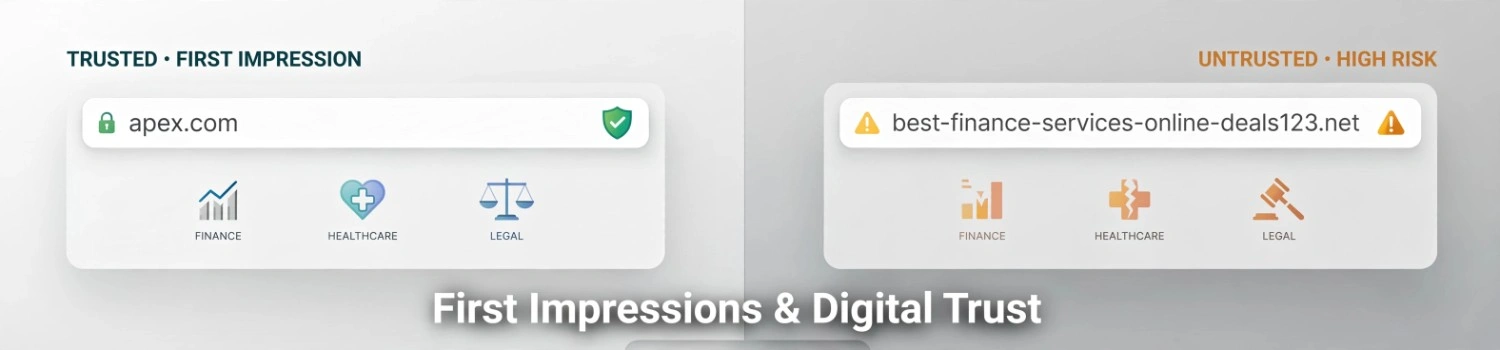
Consumers form an opinion about a website’s credibility within seconds, and the domain is often the first data point they process before the page even loads. A domain that is long, hyphenated, or hard to parse introduces a small but real moment of doubt. Conversely, a short, clean domain signals that a company invested in getting the fundamentals right, which subconsciously extends to how visitors judge the product or service itself.
This matters even more in industries where trust is transactional, such as finance, legal services, or healthcare, where a confusing domain can cost a conversion before a single word of copy is read.
Domain Length and Cognitive Load
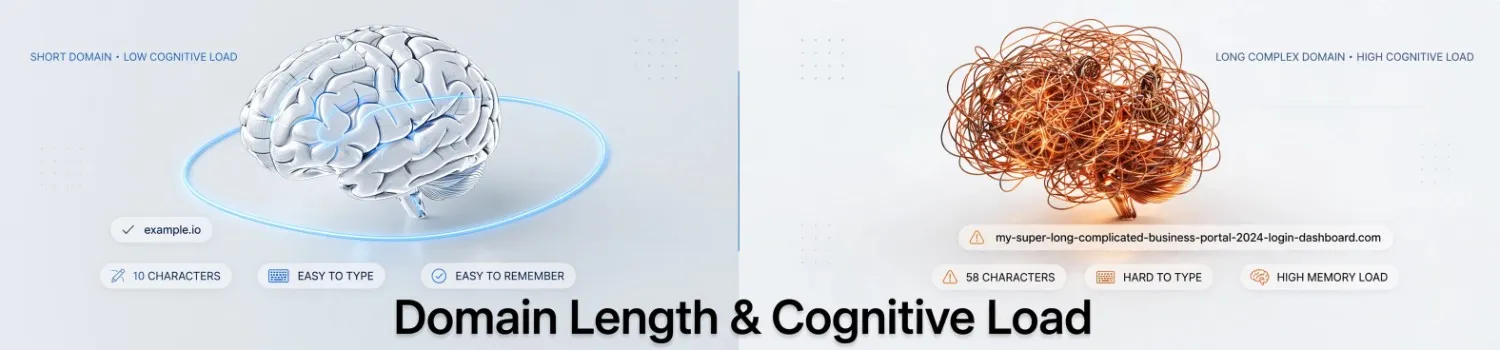
Every additional character in a domain adds a small increment of cognitive load. Usability researchers have long noted that people process short, familiar strings faster than long or irregular ones, a principle that applies directly to how visitors perceive and remember URLs. The Nielsen Norman Group’s research on URLs as user interface elements has repeatedly found that users scan and judge web addresses the same way they judge any other piece of interface copy, meaning length and clarity directly affect usability, not just aesthetics.
For a brand, this translates into a measurable difference: shorter domains are typed more accurately, remembered longer, and shared more confidently in word-of-mouth referrals.
SEO and Discoverability Implications
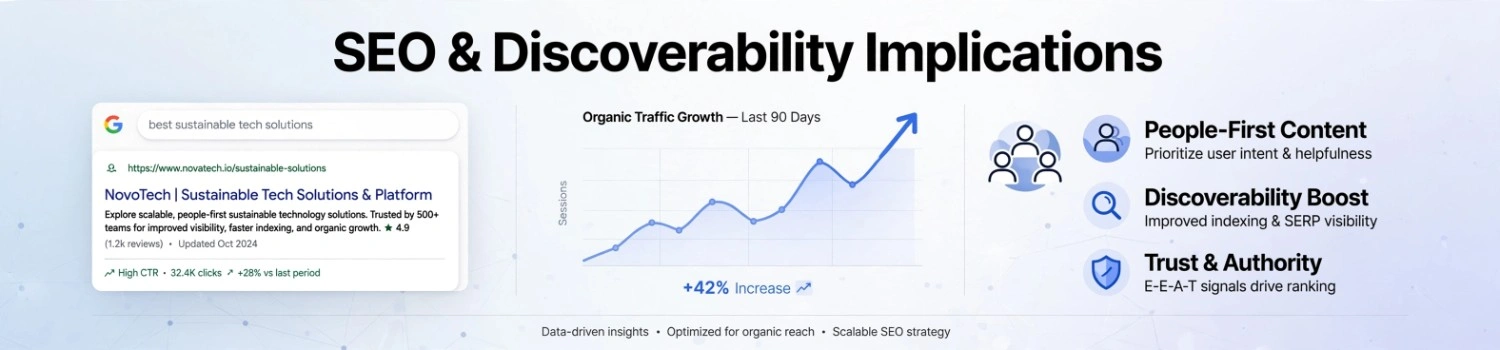
While domain length is not a direct Google ranking factor by itself, short domain name branding still influences discoverability indirectly. A memorable domain increases direct navigation traffic, strengthens branded search volume, and improves click-through rates on search results because it looks cleaner in the search snippet. Google’s own guidance on building a strong site foundation emphasizes creating a people-first, easily navigable experience, and a clear domain is part of that first impression signal, both for users and for how confidently they click through.
Over time, higher direct traffic and stronger branded search behavior tend to correlate with better overall search performance, since search engines interpret repeated, confident navigation to a domain as a trust signal.
The Business Case for Investing in a Short Domain
Buying a premium short domain is often framed as a luxury expense. In reality, it functions closer to a compounding asset. Below is a comparison of how short and long domains typically perform across the metrics that matter most to a growing brand.
| Factor | Short Domain (under 10 characters) | Long or Hyphenated Domain |
|---|---|---|
| Typed correctly on first try | High | Low to moderate |
| Recall after single exposure | Strong | Weak |
| Verbal shareability (radio, podcast, referral) | Easy | Often requires spelling out |
| Perceived brand credibility | Higher | Lower, especially with hyphens or numbers |
| Long-term resale value | Appreciates | Typically flat or declines |
| Fit across business cards, signage, packaging | Excellent | Cramped or truncated |
The pattern is consistent: a short domain reduces friction at nearly every customer touchpoint while a long domain adds small, repeated costs that accumulate over the life of the brand.
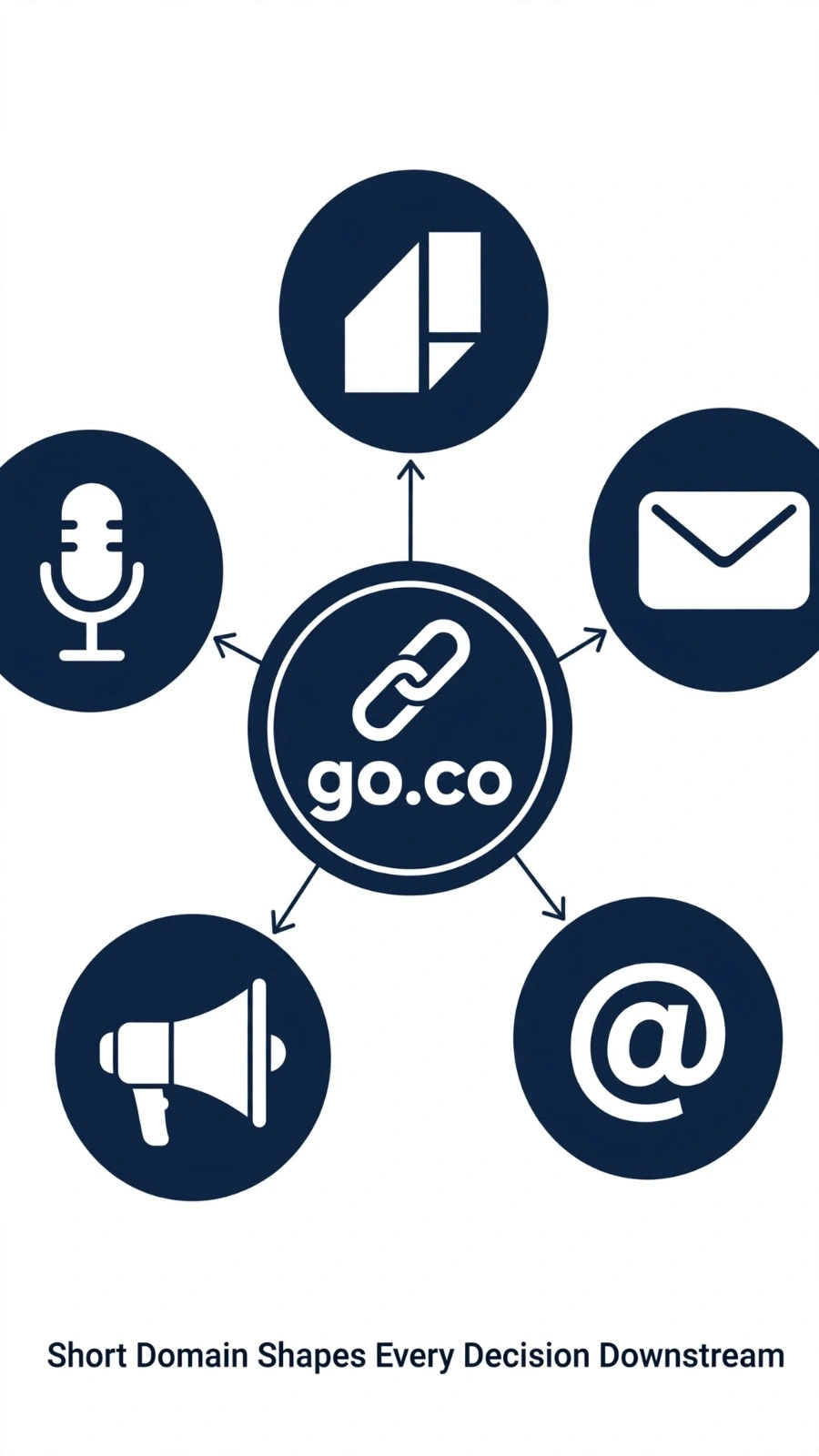
How Short Domain Name Branding Shapes Every Decision Downstream
Once a company locks in its domain, that choice quietly dictates the boundaries of nearly every identity decision that follows.
Logo and wordmark design.
Designers work more efficiently with a short, balanced name, since it is easier to create a clean lockup, favicon, and app icon that remain legible at small sizes.
Email addressing.
A concise domain produces shorter, more professional email addresses, which matters disproportionately in B2B sales, where a long or generic email domain can quietly undermine credibility.
Social media handles.
Nearly every platform has character limits and handle availability constraints, and a short domain name gives you the best odds of securing matching handles across channels.
Marketing collateral and signage.
Print materials, vehicle wraps, and trade show banners all benefit from a domain that reads clearly from a distance.
Voice search and verbal referrals.
As voice assistants and word-of-mouth referrals grow in importance, a domain that can be spoken and understood without spelling becomes a genuine competitive advantage.
In short, the domain acts as a constraint that either enables or restricts everything built on top of it. Choosing well up front means every downstream decision gets easier; choosing poorly means every downstream decision requires extra explanation.
Common Mistakes Businesses Make with Domain Branding
Even experienced founders repeat the same domain mistakes. Recognizing them early can save years of rebranding costs later.
Mistake #1 Choosing a long, descriptive domain to “explain” the business.
Descriptive domains feel safe, but they often become unwieldy and dated as the company’s offerings evolve.
Mistake #2 Relying on hyphens or numbers to secure availability.
These almost always hurt verbal shareability and are frequently mistyped or misheard.
Mistake #3 Ignoring how the domain sounds, not just how it reads.
A domain that looks fine on screen can be confusing when spoken aloud, especially across accents or in noisy environments.
Mistake #4 Underestimating resale and brand equity value.
Businesses often treat the domain as a sunk cost rather than an appreciating asset that strengthens the entire brand over time.
Mistake #5 Settling for a domain extension mismatch.
Choosing an unfamiliar or off-brand extension to “save” on the name itself frequently confuses customers who default to typing .com.
Mistake #6 Delaying the decision until after the visual identity is finished.
This backward sequencing often forces a compromised domain choice that fights against an already-finished logo and brand voice.
Avoiding these missteps is often the difference between a brand that scales smoothly and one that eventually pays for a costly, disruptive rebrand.
Expert Tips for Choosing a Brand-Ready Short Domain
Selecting the right domain is part art and part discipline. The following steps outline a practical, repeatable process.
Tip #1 Say it out loud, to a stranger, without context.
If they can repeat it back correctly on the first try, it passes the verbal test.
Tip #2 Check it at three sizes.
View the domain as it would appear on a mobile screen, a business card, and a large sign. If it holds up at all three, it is likely a strong long-term fit.
Tip #3 Confirm the .com or primary extension is available.
Even in 2026, .com remains the default assumption for most consumers, and mismatched extensions still create hesitation.
Tip #4 Search for trademark conflicts early.
A short, catchy domain is worthless if it triggers a legal dispute down the line.
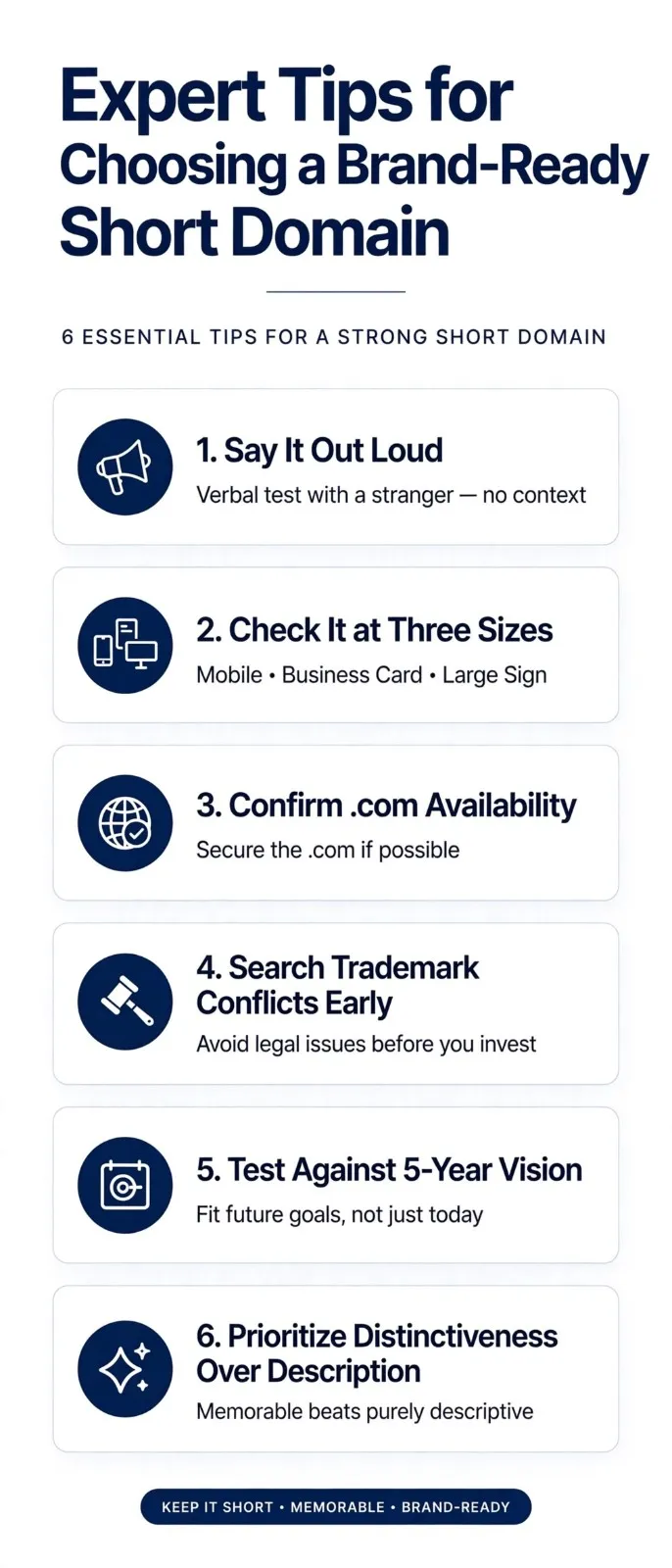
Tip #5 Test it against your five-year vision, not just today’s offering.
A domain tied too tightly to a single product can become limiting as the company expands.
Tip #6 Prioritize distinctiveness over description.
A short, unique word is easier to own in search results and in customers’ minds than a generic descriptive phrase already used by competitors.
For businesses that want to skip the lengthy discovery process, browsing a curated marketplace of short domain names for sale can shortcut months of brainstorming by surfacing options that already meet these criteria.
Short Domain Name Branding Across Industries
The principles behind short domain name branding apply broadly, but the stakes and nuances shift depending on the industry.
- E-commerce and consumer brands rely heavily on impulse recall; a short domain remembered from an Instagram ad directly drives repeat purchases.
- SaaS and technology companies benefit from short domains because product names change more often than the underlying brand, and a flexible, concise domain absorbs that evolution gracefully.
- Professional services, including legal, financial, and medical practices, use short domains to reinforce authority and reduce the friction of a client typing the address from a referral card.
- Local and regional businesses find that a short domain travels better across radio ads, vehicle signage, and community sponsorships, where verbal clarity is essential.
Across every category, the underlying logic stays the same: a shorter domain removes friction, and removed friction compounds into stronger brand recall over time.
Comparison Table: Premium Short Domain vs Generic Long Domain
| Consideration | Premium Short Domain | Generic Long Domain |
|---|---|---|
| Initial cost | Higher upfront investment | Lower or free |
| Ongoing marketing efficiency | Reduces cost per impression needed for recall | Requires more repetition to achieve recall |
| Brand flexibility | Adapts easily as offerings expand | Often locked to original description |
| Perceived maturity | Reads as an established, funded brand | Can read as early-stage or DIY |
| Long-term asset value | Retains or increases in value | Rarely appreciates |
This comparison illustrates why many growing companies eventually migrate from a long, descriptive domain to a shorter one, often at significant cost and disruption that could have been avoided with the right choice from the start.
Measuring the Return on a Short Domain Investment
Because a short domain often carries a higher upfront price tag than a freshly registered long alternative, founders reasonably want to know how to measure the return before committing budget.
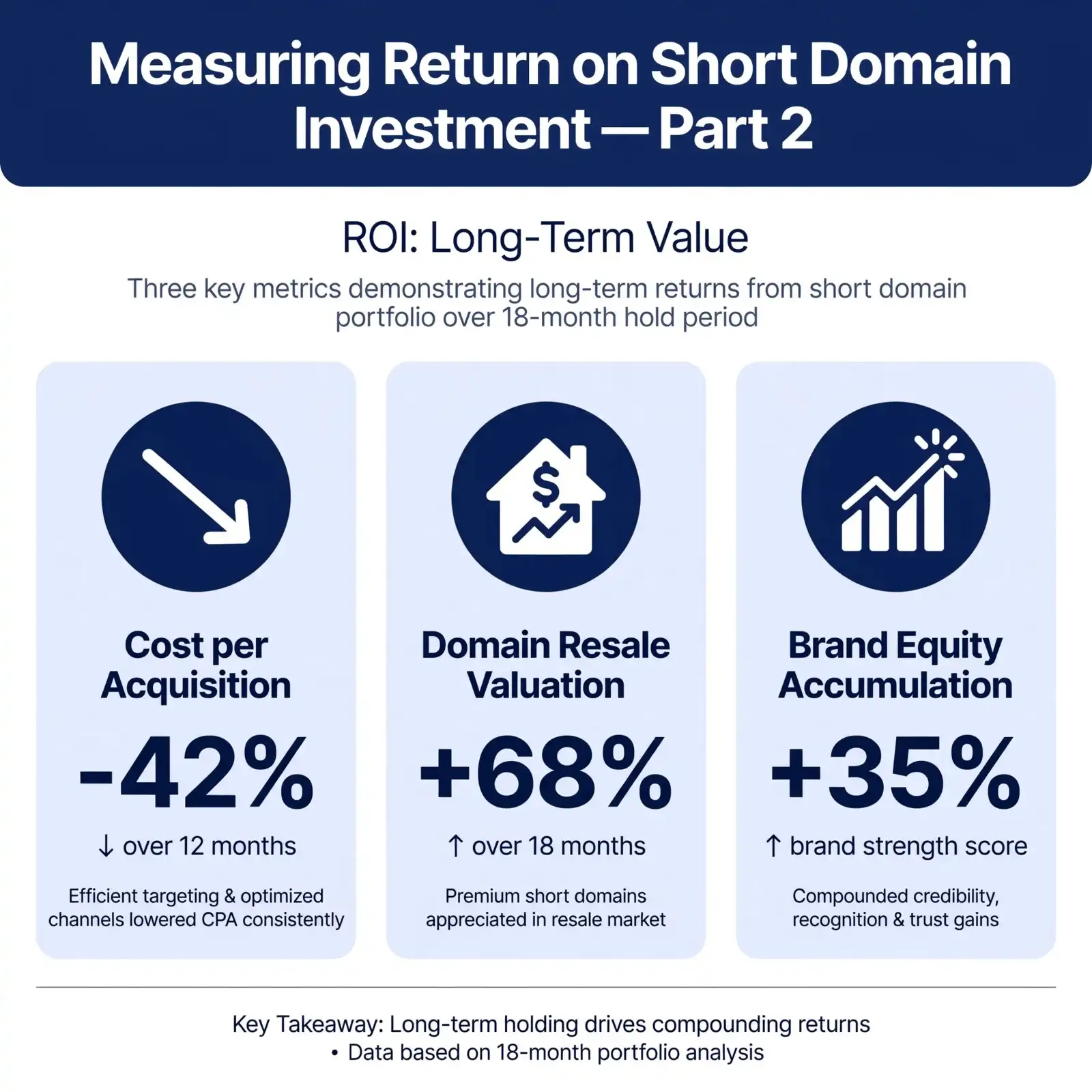
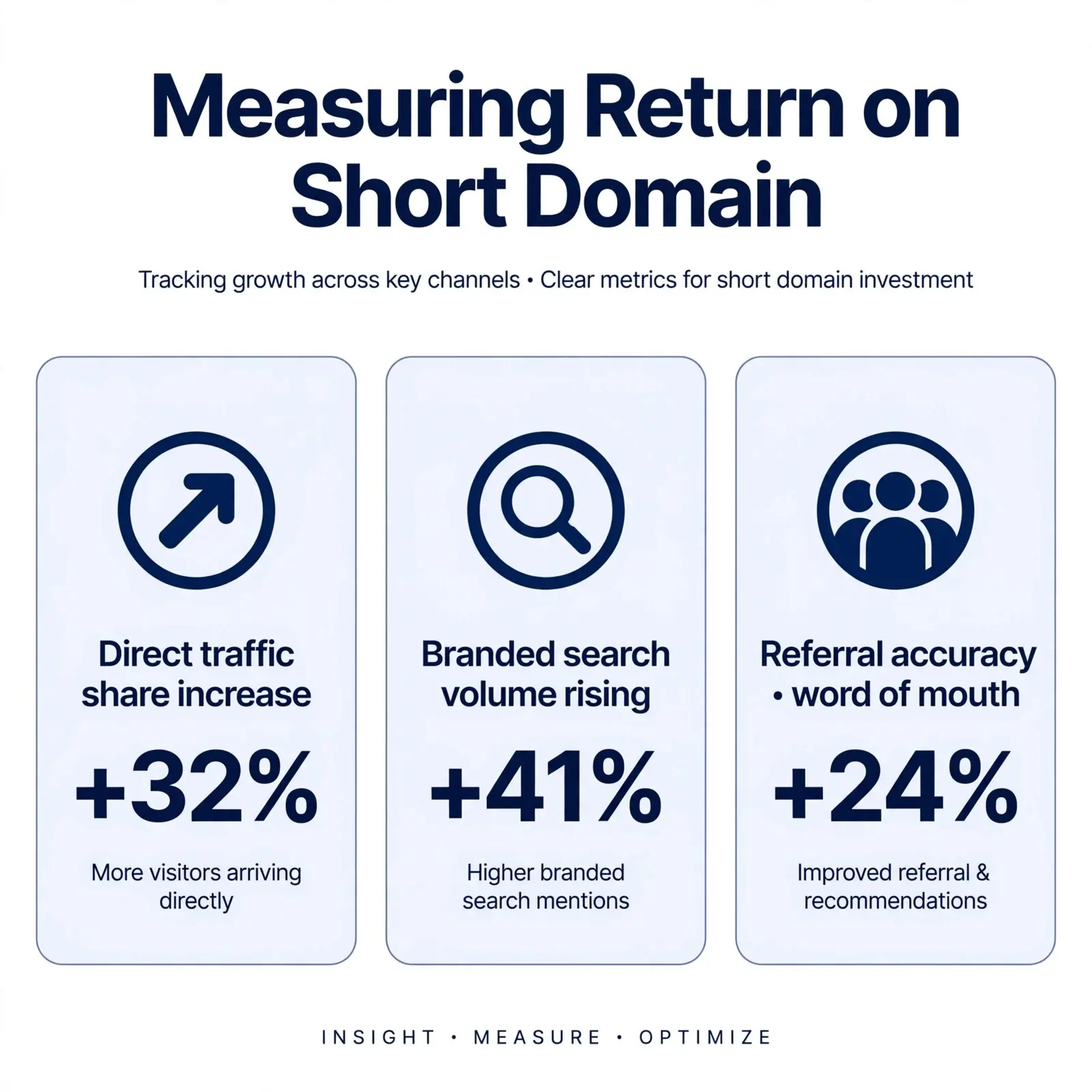
Consider tracking these indicators before and after a domain change or purchase:
Direct traffic share.
An increase in visitors typing the domain directly, rather than arriving through paid ads or search, signals growing brand recall.
Branded search volume.
A rising number of people searching for your company name by itself, rather than in combination with a category term, indicates the domain is becoming synonymous with the brand.
Referral accuracy.
Track how often customers correctly recall and type the domain after hearing it once, whether through a survey, a promo code redemption rate, or word-of-mouth attribution.
Cost per acquisition over time.
As recall improves, the number of touchpoints needed to convert a customer typically decreases, which shows up as a gradually falling cost per acquisition.
Domain resale valuation.
Even if you never plan to sell, tracking how third-party domain appraisal tools value your domain over time offers an objective proxy for how much brand equity the domain itself has accumulated.
Framed this way, a short domain purchase behaves less like a marketing expense and more like a capital investment, one that pays dividends across every channel a brand touches, from paid acquisition to organic word-of-mouth growth.
Step-by-Step: Evaluating a Short Domain Before You Buy
Before committing budget to a domain purchase, run through this evaluation sequence:
- Shortlist three to five candidates that align with your brand direction, not just current availability.
- Pronounce each one aloud to at least three people outside your company and note any hesitation or mispronunciation.
- Check search engine results for each candidate to confirm there is no dominant competitor already using a near-identical name.
- Verify trademark availability through your relevant national trademark database.
- Confirm matching social handles are available or reasonably attainable across your priority platforms.
- Review the seller’s transfer process if purchasing from a marketplace, including escrow protections and documentation. For a full breakdown of what a short domain typically costs and how pricing is structured, this guide on how much a short domain name actually costs is a useful reference before making an offer.
- Make the final decision against your five-year roadmap, not just your current product name.
Following this sequence turns domain selection from a rushed, reactive decision into a deliberate, strategic one.
The Psychology Behind Why Short Domains Stick
Understanding short domain name branding also means understanding a bit of consumer psychology. Human memory favors patterns that are compact, rhythmic, and low-effort to process, which is why short domains consistently outperform longer ones in recall studies and everyday customer behavior.
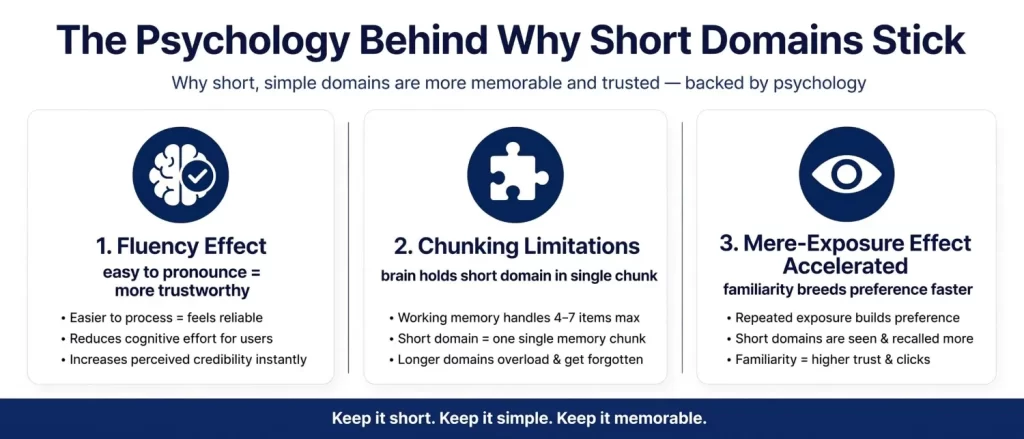
The fluency effect.
Names that are easy to pronounce are subconsciously judged as more trustworthy and higher quality, a well-documented bias in consumer psychology. A short domain benefits directly from this effect because it is almost always easier to pronounce than a longer, compound alternative.
Chunking limitations.
The human brain naturally groups information into small chunks to hold it in short-term memory. A short domain typically fits within a single chunk, while a longer domain forces the brain to split it into multiple chunks, increasing the odds of a misremembered detail.
The mere-exposure effect, accelerated.
Familiarity breeds preference, and short domains reach that familiarity threshold faster because they require fewer repeated exposures before a customer feels confident recalling and typing them correctly.
None of this is theoretical for a growing business. Faster recall translates directly into lower customer acquisition costs, because fewer repeated touchpoints are needed before a prospect converts. A brand that must repeat itself five times before a customer remembers the domain is, in effect, paying a hidden tax on every campaign it runs.
Future-Proofing Your Brand Through Domain Strategy
Businesses evolve. Product lines expand, target markets shift, and messaging matures over a company’s lifetime, yet many founders lock themselves into a domain chosen for where the business was on day one rather than where it is headed.
A genuinely future-proof domain strategy considers the following:
Category-agnostic naming.
A domain tied too closely to a single product or service can feel outdated the moment the company launches a second offering. Short, distinctive names avoid this trap because they carry brand meaning rather than literal description.
International scalability.
As companies expand into new markets, a domain that is easy to pronounce across languages and does not rely on English-specific wordplay travels further with less friction.
Acquisition and investment readiness.
Investors and acquirers often view a strong, ownable domain as a sign of brand maturity, since it demonstrates the founding team thought beyond the minimum viable product stage.
Platform independence.
Unlike a social media handle, which can be renamed, suspended, or deprecated by a third party, a purchased domain remains a permanent, fully owned asset that anchors the brand regardless of which platforms rise or fall in popularity.
Thinking about the domain as infrastructure, rather than a one-time setup task, changes how much weight the decision deserves. Infrastructure decisions are hard to reverse once a business has scaled, and a domain is no exception.
What Actually Qualifies as a “Short” Domain
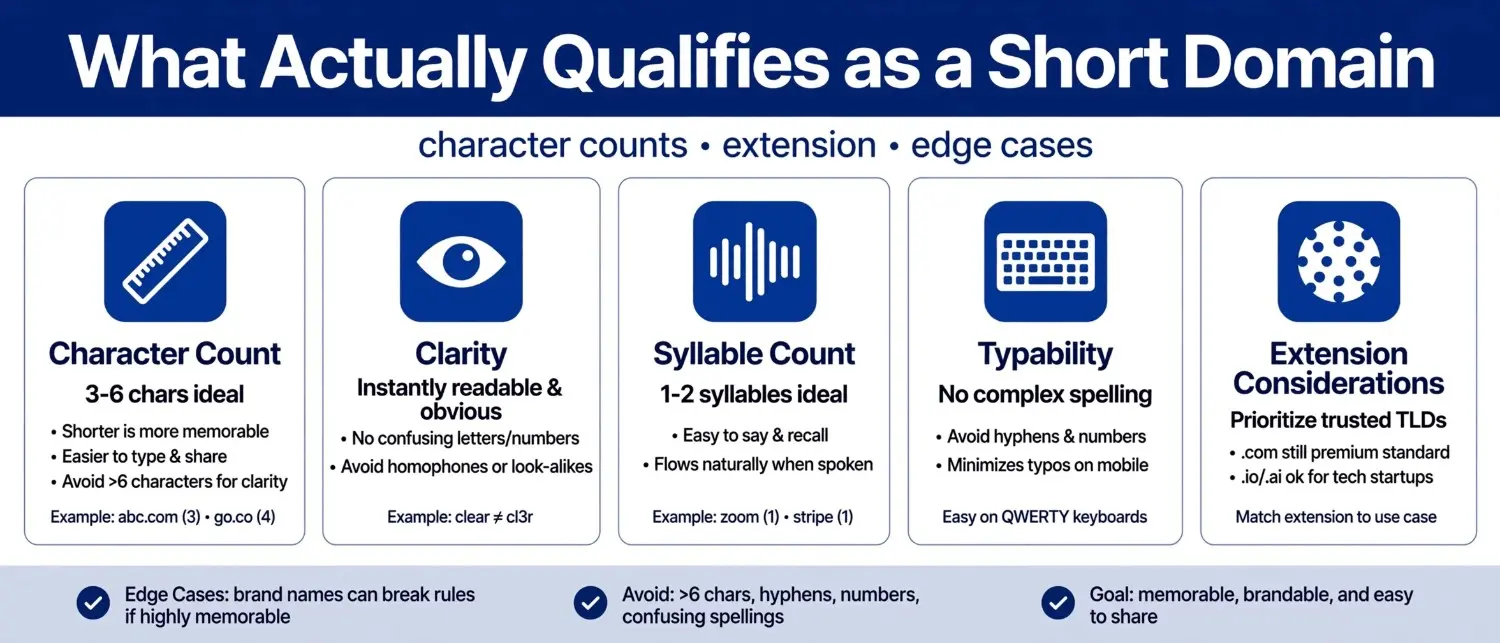
Not every brief-looking domain qualifies as genuinely short in a branding sense. Length alone is not the full story; clarity, syllable count, and typability all factor in. For a complete breakdown of the criteria that separate a truly short domain from one that merely looks compact, see this detailed explainer on what qualifies as a short domain name, which covers character counts, extension considerations, and common edge cases.
Frequently Asked Questions
What is short domain name branding?
Short domain name branding is the practice of aligning a company’s overall identity, including its name, logo, and marketing materials, around a concise, memorable domain that reduces friction for customers typing, remembering, or sharing the web address.
Why does domain length matter for brand identity?
Domain length matters because shorter domains are easier to recall, type correctly, and share verbally, which reduces friction at nearly every customer touchpoint and reinforces trust from the first impression.
Is a short domain worth the extra cost?
For most growing brands, yes. A short domain functions as an appreciating asset that improves marketing efficiency, brand recall, and long-term flexibility, often outweighing the higher upfront cost within a few years.
Does a short domain directly improve SEO rankings?
Domain length is not a direct Google ranking factor, but short domain name branding indirectly supports SEO performance by increasing branded search volume, improving click-through rates, and strengthening the trust signals search engines associate with confident, repeated direct navigation.
How short should a domain be for strong branding?
Most branding experts recommend keeping a domain under 10 to 12 characters, ideally as a single memorable word or a tight two-word combination, so it remains easy to say, type, and recall after a single exposure.
Can I rebrand later if I start with a long domain?
Rebranding is possible but costly, since it requires rebuilding search equity, updating every marketing touchpoint, and re-training customer recall from scratch. Choosing a strong short domain from the start avoids this disruption entirely.
Conclusion

Short domain name branding is not a cosmetic detail you handle after the “real” brand work is done; it is the foundation everything else is built on. From the first impression a prospective customer forms, to how easily your team can design a clean logo, to how confidently a referral gets typed into a browser, the domain shapes outcomes long before a single marketing dollar is spent. Businesses that treat this decision with the seriousness it deserves consistently save themselves years of costly rebranding down the line.
If you are ready to build your brand on a foundation that works for you instead of against you, and secure the one that will carry your business for years to come.