
Short domain name pricing spans an enormous range: a standard two-to-four-character .com domain acquired through the aftermarket typically commands anywhere from $1,000 to over $1,000,000 USD, depending on character composition, TLD authority, and keyword demand signals, while new registrations of genuinely short strings in premium TLDs like .com are essentially unavailable at standard registry pricing. The cost structure is bifurcated between newly registered short domains in secondary TLDs (which can start as low as $8-$50/year) and premium aftermarket acquisitions of legacy short .com assets, which are subject to supply-constrained speculative valuations and liquidity dynamics unique to the domain investment sector.
If you are a startup founder, brand strategist, or digital entrepreneur trying to understand how much does a short domain name cost before making a capital allocation decision, this guide will give you the complete, unfiltered pricing reality – from the registry floor to the aftermarket ceiling.
What Exactly Qualifies as a “Short” Domain Name?
Before diving into pricing tiers, it helps to anchor the definition. The domain industry broadly classifies short domains by character count:
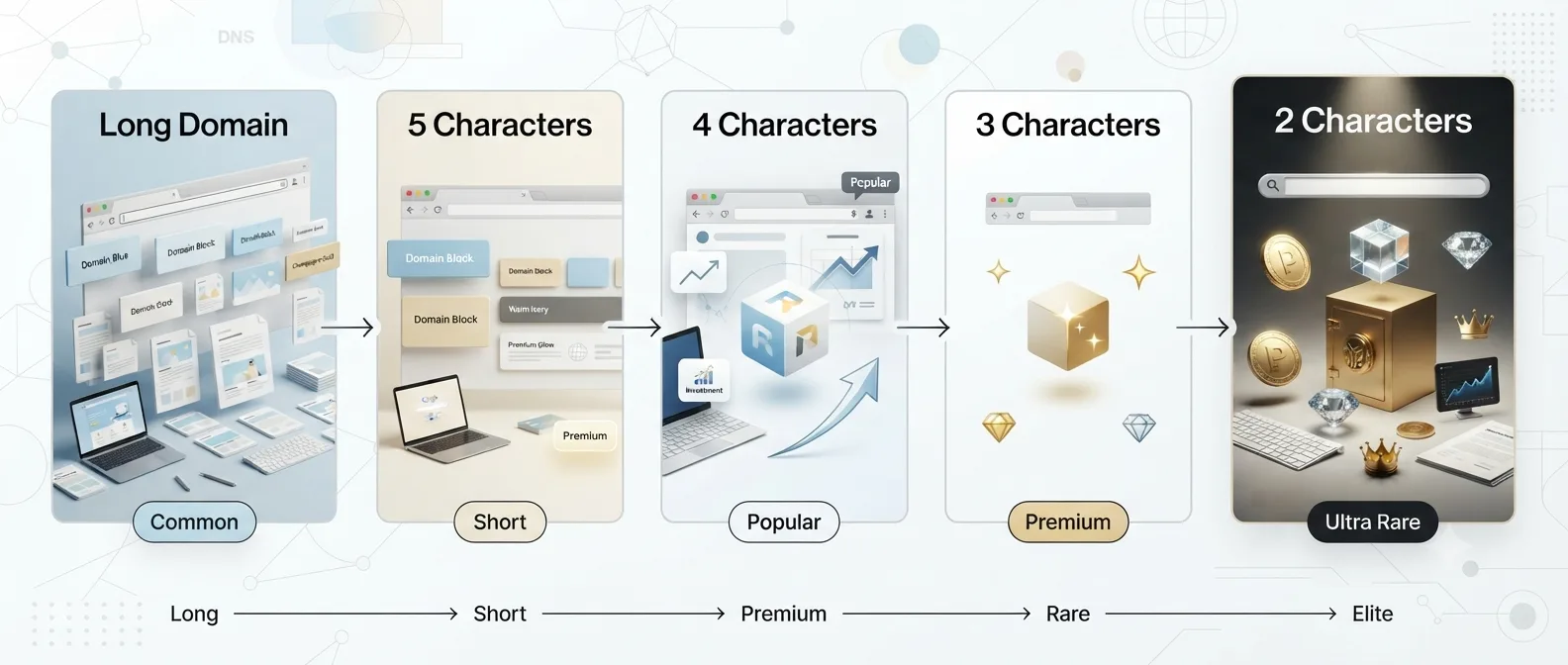
- 2-character (2L, 2N): Two letters or two numbers. Extremely rare, mostly legacy-registered.
- 3-character (3L, 3N): Three letters or three numbers. The most liquid premium short domain tier.
- 4-character (4L, 4N): Four letters or numbers. The entry point for most buyers entering the short domain market.
- 5-character: Transitional – still considered short when they form genuine acronyms or dictionary words.
Character composition also dramatically affects pricing. A 3-letter domain composed of high-frequency consonants and vowels (like “BET.com” or “CAR.com”) carries vastly different demand than a string built on rare letters like Q, X, or Z – though even those carry premiums due to perceived scarcity.
If you want a deeper understanding of the technical definition and why these distinctions matter for valuation, the KRDEN guide on what qualifies as a short domain name and why the definition matters provides an excellent technical breakdown.
The Core Pricing Tiers: A Market-Level Overview
Understanding short domain name costs means understanding that there is no single market. There are at least four distinct pricing environments operating simultaneously:
1. Standard Registry Pricing (New Registrations)
This is where most buyers start – and where most buyers hit their first wall.
For the .com TLD, virtually every single-word, 2L, 3L, and most 4L combinations were registered decades ago. The probability of finding an unregistered short .com is near zero.
What you can register as a new domain:
| Domain Type | Average Registration Cost | Annual Renewal |
|---|---|---|
| Short .io (4-5 chars) | $35 – $65 | $35 – $65 |
| Short .co (4-5 chars) | $25 – $40 | $25 – $40 |
| Short .ai (4-5 chars) | $70 – $120 | $70 – $120 |
| Short .xyz (3-4 chars) | $2 – $15 | $2 – $15 |
| Short .net / .org (4-5 chars) | $10 – $18 | $10 – $18 |
| Short .com (5+ chars, available) | $10 – $15 | $10 – $15 |
The important caveat: even these alternative TLDs often have premium pricing tiers set by the registry itself for desirable short strings.
2. Aftermarket Premium Domains (Secondary Market)
This is where the real short domain name pricing conversation happens. Platforms like Sedo, Afternic, GoDaddy Auctions, and Dan.com host thousands of short domain listings – but the prices reflect scarcity economics.
Typical aftermarket pricing by domain class:
| Domain Class | Typical Price Range | Notes |
|---|---|---|
| 2L .com | $500,000 – $5,000,000+ | Near-impossible to acquire; rarely listed |
| 3L .com | $15,000 – $500,000+ | Liquid market; strong investor demand |
| 4L .com (no Q/Z) | $1,500 – $25,000 | High volume; most accessible premium tier |
| 4L .com (with Q/Z) | $300 – $2,500 | Discounted for “low-quality” letters |
| 3N .com (numbers) | $10,000 – $150,000+ | Strong demand from Chinese buyers |
| 4N .com | $800 – $8,000 | Active secondary market |
| 3L .io / .co | $500 – $15,000 | Growing demand from tech startups |
| 5L pronounceable .com | $500 – $10,000 | Depends heavily on phonetics |
3. Brokered Private Sales
Many of the most valuable short domains never hit public auction. Instead, they trade hands through domain brokers who negotiate privately between parties. In this tier:
- Prices are not published.
- Transactions often involve NDAs.
- Broker commissions typically range from 10% to 20% of the sale price.
- Deals can close in the millions of dollars for premier assets.
If you are pursuing a specific 2L or 3L .com for a major brand, private brokerage is usually the only viable channel.
4. Expired Domain Auctions
Domains drop from registration for various reasons – non-renewal, company closures, portfolio liquidations. Platforms like NameJet, DropCatch, and GoDaddy Auctions offer these expired names, often at lower prices than listed aftermarket domains.
However, for short domains specifically, competition is fierce. Popular 3L and 4L .coms that drop often attract dozens of bidders, driving auction prices into the thousands regardless.
Why Short Domain Names Cost So Much: The Economic Reality
The pricing structure for short domains is not arbitrary – it reflects several converging economic forces.
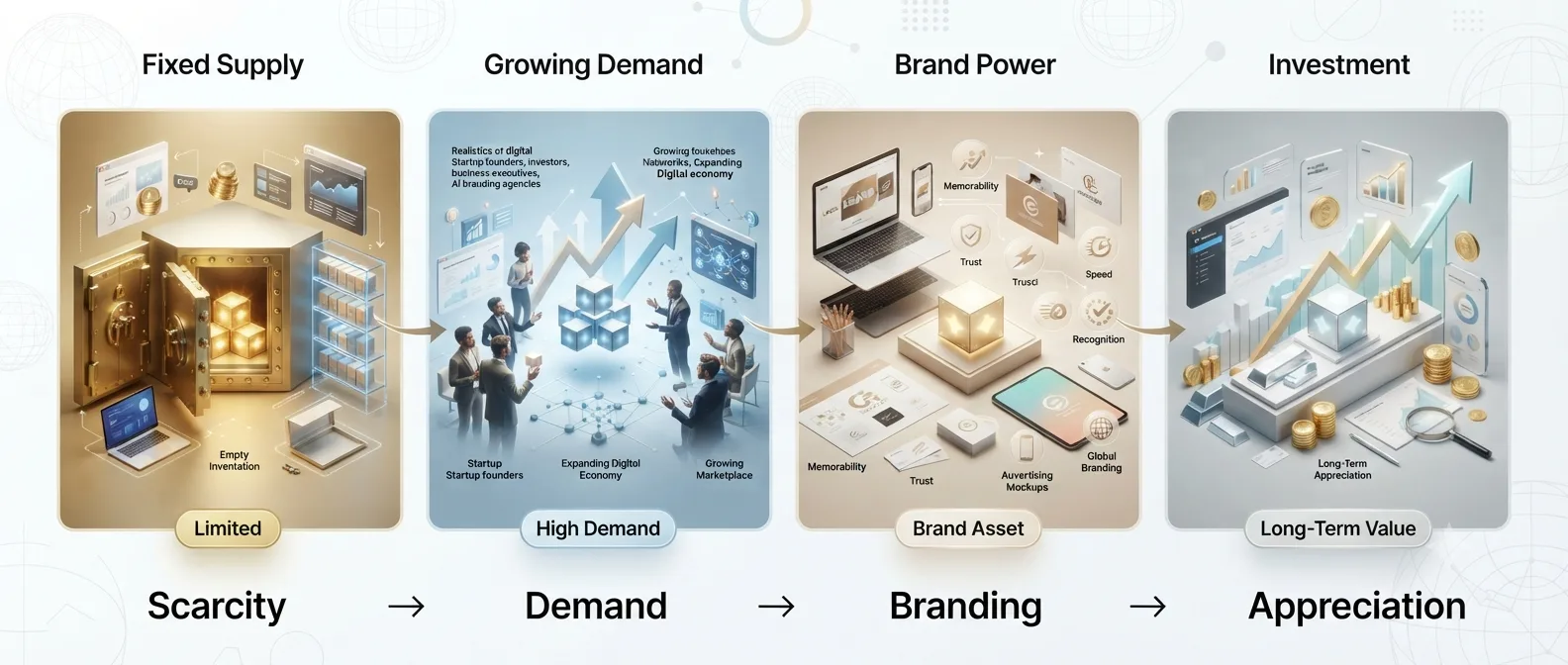
Supply Is Permanently Fixed
There are exactly 676 possible two-letter .com combinations (26 x 26) and 17,576 possible three-letter combinations. Every single one of these was registered years ago. The supply will never increase. This permanent scarcity is the foundational driver of premium pricing.
According to Verisign’s domain industry brief, the .com zone file contains over 160 million registered domains, with essentially zero meaningful short combinations available for standard registration.
Demand Continues to Grow
As the global internet economy expands, so does the demand for memorable, brandable digital identities. New startups, DTC brands, blockchain projects, and AI ventures all compete for the same finite short domain inventory. This demand-side pressure consistently pushes prices upward over time.
Brandability Carries a Premium
A short domain is not merely a URL – it is a brand asset. Consider what companies pay for a name that is:
- Easy to type on a mobile keyboard.
- Impossible to misspell.
- Memorable after a single hearing.
- Immune to typosquatting.
These functional benefits translate directly into marketing efficiency, customer acquisition cost reduction, and brand equity accumulation. When enterprises calculate the ROI of a premium short domain, the acquisition cost often looks modest relative to the lifetime marketing value.
Investment Demand Inflates Prices
Domain investors – often called “domainers” – purchase short domains as speculative assets, holding them until an end-user buyer arrives. This creates a two-layer market: the investor floor price (the minimum they will accept to generate a return) and the end-user ceiling price (what a brand is willing to pay for the strategic value). Most aftermarket pricing sits somewhere between these poles.
How Much Does a Short Domain Name Cost by Use Case?
Different buyers have different needs, and the pricing landscape looks different depending on your specific situation.
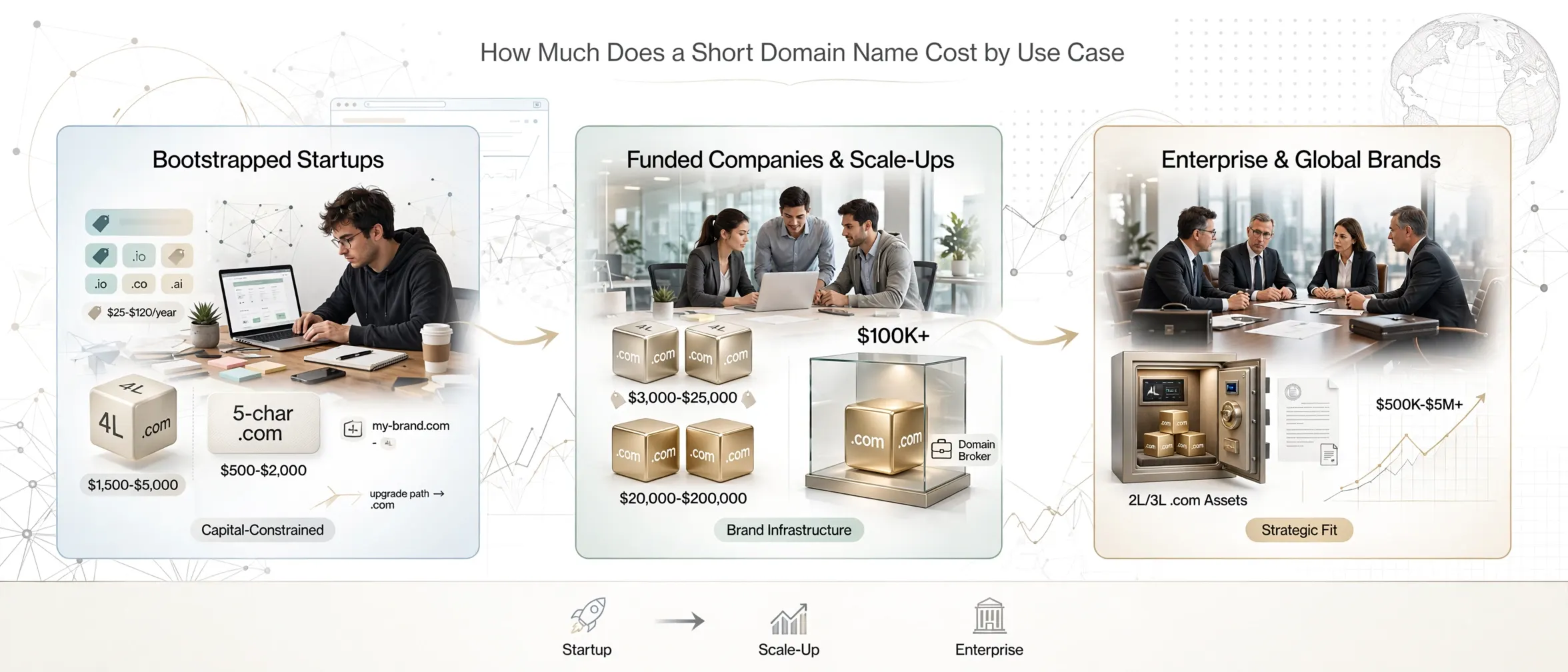
For Bootstrapped Startups
If you are early-stage and capital-constrained, your realistic options are:
- Register a short domain in an alternative TLD (.io, .co, .ai) for $25-$120/year.
- Buy a 4L .com with common letters in the $1,500-$5,000 range.
- Find a 5-character pronounceable .com in the $500-$2,000 range.
- Consider a short hyphenated domain – though these carry branding disadvantages.
The strategic move for most startups is to secure a quality short alternative TLD domain now and plan for a .com upgrade once funding rounds allow.
For Funded Companies and Scale-Ups
Series A and B companies with meaningful marketing budgets typically target:
- 4L .com domains: Budget $3,000-$25,000.
- 3L .com domains: Budget $20,000-$200,000 for less-common letter combinations.
- Premium 3L or 2L .com: Requires $100K+ and often involves a domain broker.
At this stage, the domain purchase is typically treated as a brand infrastructure investment, not an operating expense.
For Enterprise and Global Brands
Major enterprises building new brand lines or rebranding existing ones may target 2L or 3L .com assets regardless of price. At this level:
- Budget considerations are secondary to strategic fit.
- Acquisitions of $500K-$5M+ are not uncommon.
- Legal teams get involved to verify clean title history and transfer processes.
Hidden Costs You Must Factor In
When calculating how much a short domain name costs, the acquisition price is only the beginning. Factor in these additional costs:
Annual Renewal Fees
Even after you pay $20,000 for a 4L .com, you pay $10-$15/year in renewal fees indefinitely. Miss a renewal, and you lose the domain to a drop-catcher within hours.
Transfer Fees
Moving a domain between registrars typically costs $8-$20 per transfer and may lock the domain for 60 days post-transfer.
Domain Broker Commission
If you use a broker to source or negotiate a domain, expect to pay 10%-20% of the sale price in commission. On a $50,000 domain, that is $5,000-$10,000 in brokerage fees.
Escrow Service Fees
Reputable high-value domain transactions use escrow services like Escrow.com to protect both parties. Escrow fees typically run 0.89%-3.25% of the transaction value depending on amount and payment method.
Legal and Due Diligence Costs
For acquisitions above $50,000, many buyers hire attorneys to:
- Review the domain’s trademark conflict exposure.
- Verify the chain of title.
- Draft or review purchase agreements.
Legal costs can add $500-$5,000+ depending on complexity.
SSL Certificates and Infrastructure
A short domain without proper SSL and DNS infrastructure is not a functional business asset. Budget for:
- SSL certificate: $0-$300/year depending on type.
- DNS management: $0-$50/year.
- Domain privacy/WHOIS protection: $5-$20/year.
Pricing Red Flags: What to Watch Out For
The short domain market has its share of pitfalls. Here are the key warning signs that a deal may not be what it seems:
Artificially Inflated Appraisals
Free domain appraisal tools like GoDaddy’s estimator are widely known to produce inflated valuations. A tool saying a domain is worth $50,000 does not mean any buyer will pay that. Real market value is determined by comparable sales data – not algorithmic estimates.
For reliable comparable sales data, NameBio maintains one of the most comprehensive public databases of historical domain sales and is an essential resource for any serious short domain buyer.
Trademark Conflicts
A short domain with a compelling letter combination may already be trademarked by a major brand in your industry. Using such a domain could expose you to UDRP (Uniform Domain-Name Dispute Resolution Policy) proceedings, which could result in losing the domain entirely – even after paying a premium for it.
Always conduct a trademark clearance search through the USPTO trademark database before finalizing any domain acquisition.
Unusual TLD Risks
Some alternative TLDs are controlled by single countries or organizations that can revoke domains under specific circumstances. For example, certain country-code TLDs (ccTLDs) have local residency requirements. Understand the governance rules of any non-.com TLD before investing significantly.
Domains with Spam or Penalty History
A short domain may have been used previously for spam, black-hat SEO, or malicious purposes. Before purchasing any aged domain, run it through tools like the Wayback Machine and check its backlink profile for toxic link patterns.
Comparison: Short Domain Name vs. Long Domain Name Costs
It helps to contextualize short domain pricing against the alternatives.
| Factor | Short Domain (3-4 chars) | Medium Domain (8-12 chars) | Long Domain (15+ chars) |
|---|---|---|---|
| .com availability | Near zero (aftermarket only) | Low to moderate | High |
| Average acquisition cost | $1,500 – $200,000+ | $100 – $5,000 | $10 – $500 |
| Annual renewal | $10 – $15 | $10 – $15 | $10 – $15 |
| Brand memorability | Very high | Moderate | Low |
| Mobile typing ease | Very high | Moderate | Low |
| Typo risk | Very low | Moderate | High |
| Long-term brand ROI | Very high | Moderate | Lower |
The cost differential between a short and long domain is substantial upfront – but when modeled against lifetime brand value, customer recall rates, and reduced typosquatting risk, the economics of premium short domains often justify the investment for scaling businesses.
How to Evaluate Whether a Short Domain Is Worth the Price
Use this decision framework before committing:
Step 1: Define Your Brand Requirements
Ask yourself:
- Does this domain need to stand alone as a brand, or will it function alongside an existing brand name?
- Is .com essential, or can an alternative TLD work for your target audience?
- How important is voice search compatibility? (Short domains are inherently voice-friendly.)
Step 2: Research Comparable Sales
Visit NameBio and search for similar character combinations, TLDs, and lengths. Look at what comparable domains actually sold for in the last 12-24 months. This establishes a real market baseline.
Step 3: Calculate Your Brand Value Upside
Estimate what improved brand recall is worth to your business annually. If a shorter domain reduces your customer acquisition cost by even 5% annually, what does that represent in dollar terms over five years? For most growth-stage companies, the math consistently favors investment in a short, memorable domain.
Step 4: Negotiate Strategically
Sellers of premium short domains expect negotiation. Starting 30%-40% below the asking price is standard. Many sellers will counter-offer. If a seller lists a 4L .com at $8,000, opening at $5,000-$5,500 is reasonable.
Step 5: Use Escrow for Any Transaction Above $500
Never send payment directly to a seller without escrow protection. The short domain market, while largely professional, does attract fraudulent listings – particularly for highly desirable strings.
Practical Tips for Buying Short Domains at the Best Price
Even in a supply-constrained market, smart buyers find value. Here are the strategies that work:
- Monitor expiring domains daily. Set alerts on NameJet, DropCatch, and GoDaddy Auctions for character patterns you are targeting.
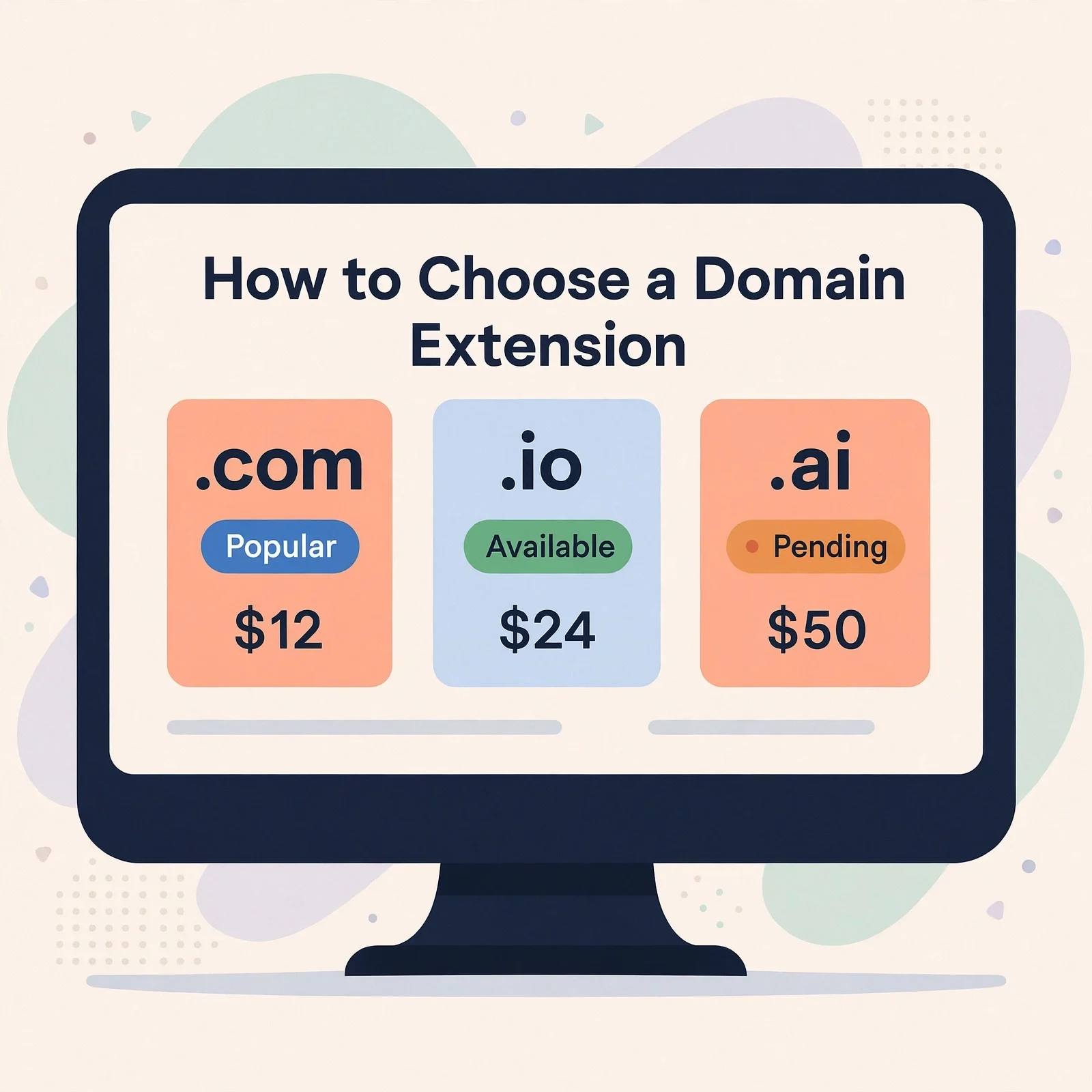
- Target less-common alternative TLDs early. As .ai and .io gain legitimacy, their short domain premiums are rising. Early acquisition locks in lower prices.
- Buy during market downturns. Domain prices fluctuate with broader tech investment cycles. Periods of reduced venture funding often correlate with lower domain seller expectations.
- Bundle purchases. If a seller holds multiple short domains you want, negotiating a bundle deal often yields significant per-domain discounts.
- Work with a buyer’s broker. For acquisitions above $10,000, a domain buyer’s broker can often source options you cannot find publicly and negotiate more effectively than you can independently.
- Check parking revenue. A short domain generating consistent type-in traffic and parking revenue is more expensive – but it also means it has provable direct navigation value.
Real-World Short Domain Sale Examples
To ground the pricing data in reality, here are notable short domain sales from public records:
| Domain | Sale Price | Year | Notes |
|---|---|---|---|
| FB.com | ~$8,500,000 | 2010 | Acquired by Facebook |
| Sex.com | $13,000,000 | 2010 | Record holder at the time |
| Cars.com | $872,000,000 | 2017 | Keyword + short combination |
| Voice.com | $30,000,000 | 2019 | Short keyword .com |
| AI.com | $11,000,000+ | 2023 | Acquired by OpenAI |
| MM.com | Undisclosed | Private | 2L .com, multi-million estimated |
These headline figures represent the extreme end of the market. However, they demonstrate the genuine asset value embedded in short domain names and help explain why even “average” short .coms command prices well above standard registration costs.
Short Domain Name Cost: Key Takeaways
Let’s consolidate the core pricing intelligence:
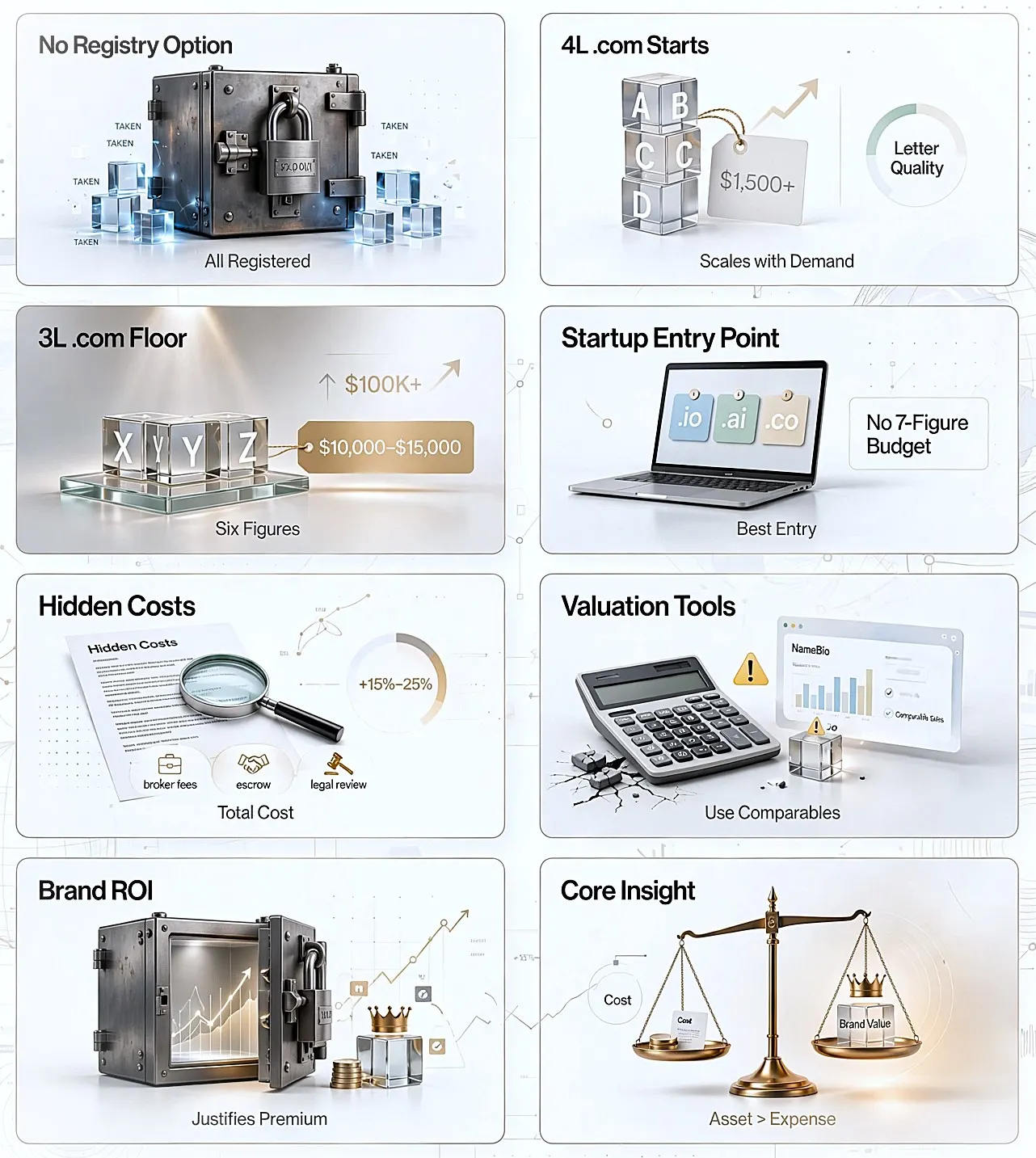
- Standard registry pricing for truly short .coms is not an option – they are essentially all registered.
- Aftermarket pricing for 4L .coms starts around $1,500 and scales rapidly with letter quality and demand.
- 3L .coms rarely trade below $10,000-$15,000 in today’s market, with premium combinations reaching six figures.
- Alternative TLDs (.io, .ai, .co) offer the best entry point for startups that need a short domain without a seven-figure budget.
- Hidden costs including broker fees, escrow, legal review, and renewals can add 15%-25% to your total acquisition cost.
- Domain valuation tools produce unreliable estimates – always rely on comparable sales data from platforms like NameBio.
- The long-term brand ROI of a quality short domain consistently justifies premium acquisition costs for scaling businesses.
Frequently Asked Questions
Q: How much does a short domain name cost on average?
A: The average cost of a short domain name depends heavily on length and TLD. Four-letter .com domains typically range from $1,500 to $25,000 on the aftermarket. Three-letter .coms generally start around $10,000-$15,000 and climb into the hundreds of thousands for premium combinations. Alternative TLDs like .io or .ai offer short character domains starting from $35-$120 per year at registration.
Q: Can I register a short .com domain for the standard $10-$15 price?
A: In practice, almost no genuinely short .com domains (2, 3, or 4 characters) remain available for standard registration. Every meaningful combination was registered years ago. Your options are the aftermarket, expired domain auctions, or alternative TLDs.
Q: Why do short domain names cost so much more than longer ones?
A: Short domains command premium pricing because supply is permanently fixed – there are only a limited number of possible character combinations – while demand from businesses, brands, and domain investors grows continuously. Their superior memorability, voice-search compatibility, and brandability also create measurable marketing value that justifies higher prices.
Q: What is the cheapest way to get a short domain name?
A: The most affordable path is to register a short domain in an alternative TLD such as .xyz, .co, .io, or .ai. Many 4-5 character combinations remain available in these TLDs at standard registry pricing. If you specifically need a .com, targeting 4-letter combinations with less common letters (Q, Z, X) through aftermarket platforms is typically the most budget-accessible entry point, sometimes available in the $300-$1,500 range.
Q: Are short domain names a good investment?
A: Premium short domain names – particularly 3L and 4L .coms – have demonstrated consistent value appreciation over time due to permanent supply constraints and growing global demand. However, like any speculative asset, liquidity varies, and carrying costs (renewal fees, broker commissions upon sale) must be factored into any return calculation. For businesses buying to use rather than to resell, the brand ROI calculation is typically more straightforward and often very favorable.
Q: How do I know if a short domain is priced fairly?
A: Check comparable sales data on platforms like NameBio, which aggregates historical domain sale records. Look for domains with similar character length, letter composition, and TLD that have transacted in the last 12-24 months. This provides a reliable market baseline independent of seller-stated valuations or algorithmic appraisal tools.
Q: Does the TLD significantly affect how much a short domain name costs?
A: Yes – substantially. A 3L .com will cost dramatically more than a 3L .io, .co, or .ai. The .com TLD carries the highest trust, recognition, and demand premium globally. However, for tech and startup audiences specifically, .io and .ai have gained significant legitimacy and their short-domain premiums are rising as a result.
Is a Short Domain Worth the Cost for Your Business?
The answer to how much does a short domain name cost is not a single number – it is a spectrum shaped by TLD authority, character composition, market timing, and your negotiation skill. For most businesses, the real question is not whether short domains are expensive but whether the brand value they create exceeds their acquisition cost.

For a bootstrapped startup, a quality short domain in .io or .ai at $50-$120/year is an intelligent, affordable starting position. For a funded company ready to build serious brand equity, a $5,000-$25,000 investment in a 4L .com is often the smartest infrastructure decision you can make in Year 1.
If you are ready to explore what is available in the premium short domain market today, browse our curated inventory of short domain names for sale at KRDEN – where every listing is hand-selected for brand potential, character quality, and market-realistic pricing.
The right short domain is not just a URL. It is a compounding brand asset that pays dividends for the entire life of your business.
Pingback: AI Companies Buying Short Domain Names: Why They Lead