
A domain name is technically classified as “short” when its second-level label (the registrable portion, excluding the TLD) contains six characters or fewer – with the industry’s premium tiers recognizing two-character (2L), three-character (3L), four-character (4L), five-character (5L), and six-character (6L) domains as distinct asset classes governed by fixed supply constraints and exponential scarcity curves. Character count, however, is only one dimension of this definition: cognitive load reduction, phonetic brevity, typographic compactness, and brandability index all determine whether a domain truly functions
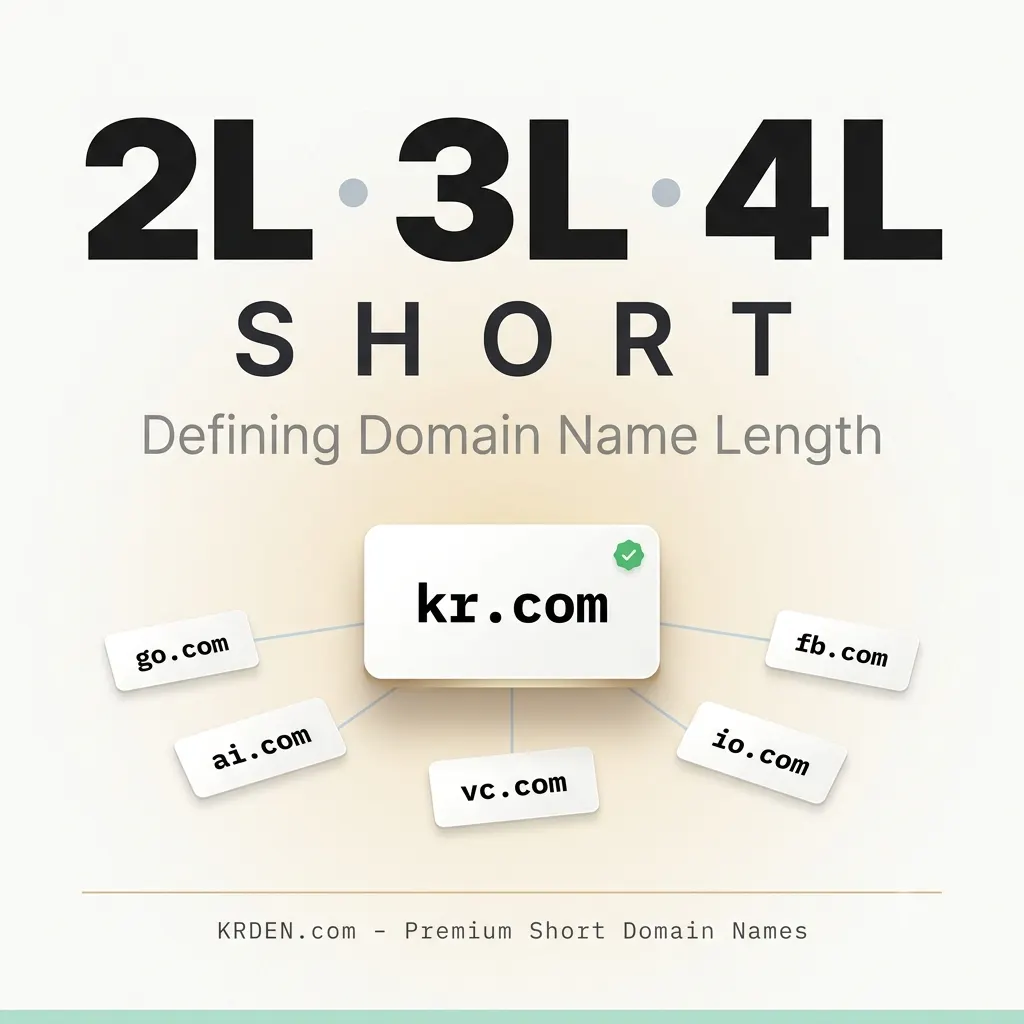
as “short” in practice. Understanding what makes a domain name short, in the full technical and commercial sense, is foundational to evaluating domain assets, protecting brand equity, and making high-confidence acquisition decisions.
If you are searching for premium short domain names for sale or trying to evaluate whether a specific domain qualifies as a short-form digital asset, understanding the precise industry definitions – and the market forces that shape them – will change how you shop, invest, and build online.
If you want to skip the research and go straight to acquisition, browse our curated inventory of short domain names for sale at KRDEN – where every listing meets strict brevity, brandability, and extension-quality criteria.
The Technical Baseline: What Character Count Defines “Short”?
To understand what makes a domain name short, start with the technical architecture. According to ICANN’s domain name structure guidelines, a standard domain label can contain between 1 and 63 characters. The full domain name – including dots and the TLD – cannot exceed 253 characters.
That is the technical ceiling. The commercial floor is quite different.
In domain investing, branding, and digital asset acquisition, the term “short domain” is not defined by ICANN. Instead, it is defined by the market: specifically, by the relationship between character count, availability, and the price premiums that buyers consistently pay.
Here is how the industry broadly categorizes domain length:
| CHARACTER COUNT (SLD ONLY) | INDUSTRY CLASSIFICATION | AVAILABILITY (APPROX., .COM) |
|---|---|---|
| 1 character | Ultra-rare / reserved | Effectively 0 available |
| 2 characters (2L) | Ultra-premium | All registered; secondary market only |
| 3 characters (3L) | Premium Tier 1 | All registered; secondary market only |
| 4 characters (4L) | Premium Tier 2 | Essentially all registered |
| 5 characters (5L) | Short – high value | Largely registered; limited availability |
| 6 characters (6L) | Short – standard tier | Mostly registered; some available |
| 7-9 characters | Medium – brandable range | Partially available |
| 10+ characters | Standard / descriptive | Broadly available |
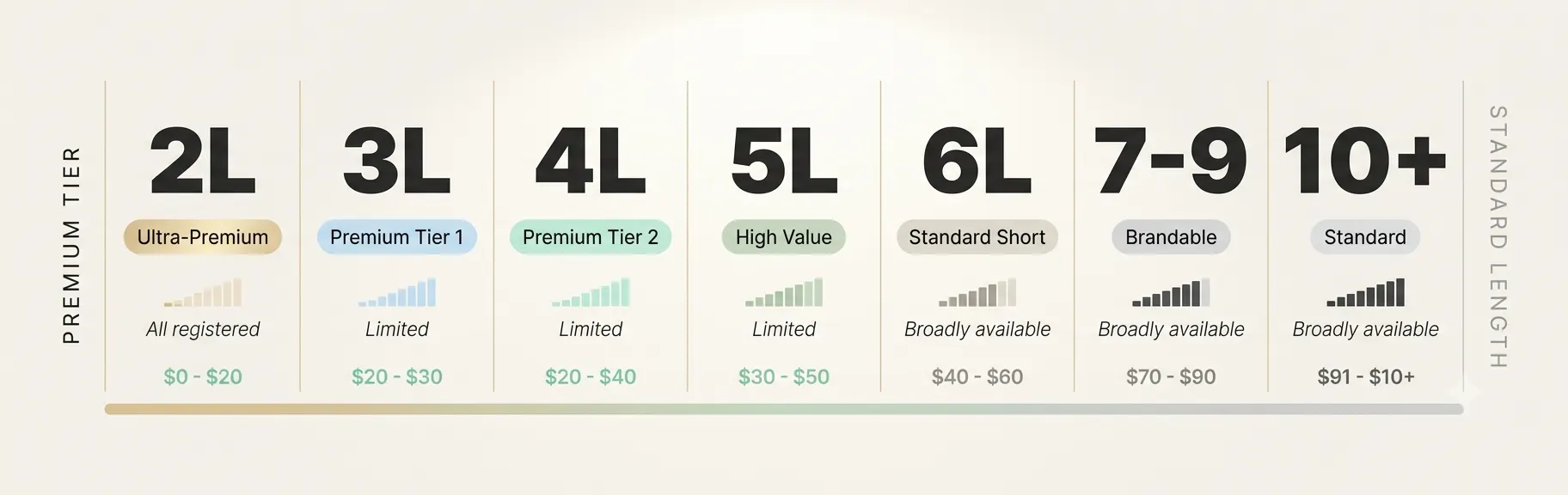
SLD = Second-Level Domain (the part before the dot, e.g., “krden” in krden.com)
The consensus among domain brokers, investors, and brand strategists places the “short domain” threshold at six characters or fewer. Some practitioners extend this to seven or eight characters for especially clean, phonetically compact names – but six remains the widely accepted upper boundary for premium classification.
Why Character Count Alone Does Not Tell the Whole Story
Raw character count is a necessary starting point, but it is not the complete definition of what makes a domain name short in a commercially meaningful sense.
Consider two five-character domains:
- “apple.com” – five characters, instantly recognizable, one clean syllable
- “xvqzp.com” – five characters, completely unpronounceable, zero brandability
Both are five characters. Only one is actually “short” in the way the market rewards.
The more precise definition of a short domain combines several measurable attributes:
- Character count: Six or fewer characters in the SLD
- Syllable count: Two syllables or fewer (ideally one)
- Phonetic simplicity: Easily pronounced without instruction
- Spelling predictability: Typed correctly on first attempt by most users
- Cognitive load index: Minimal working memory required to encode and recall
- Radio test compliance: Understood correctly when spoken aloud, without spelling it out
A domain that fails two or more of these criteria may be technically short by character count, but it does not deliver the commercial and cognitive benefits that justify a short domain’s premium valuation.
As domain length research consistently shows, the brain processes shorter visual strings more efficiently – reducing the effort required to remember, type, and recognize a name across repeated exposures. That neurological efficiency is the actual product being purchased when someone acquires a short domain.
The Premium Tiers: 2L, 3L, 4L, 5L, and 6L Domains Explained
The domain industry has developed a precise shorthand for categorizing short domains by character tier. Each tier carries distinct scarcity, liquidity, and valuation characteristics.
2L Domains (Two-Letter .com)
Two-letter .com domains represent the apex of domain scarcity. With only 676 possible letter combinations (26 x 26), every 2L .com has been registered for decades. These assets trade exclusively on the secondary market, typically in the six- to seven-figure range. Examples include FB.com, AI.com, and VC.com.
They function less as brand names and more as acronym-ready corporate identifiers – capable of representing any company whose initials align.
3L Domains (Three-Letter .com)
Three-letter domains, often abbreviated as LLL.com or 3L.com, total 17,576 possible alphabetic combinations. Every one is registered. Secondary market values range from four figures for obscure consonant clusters to six-plus figures for premium pronounceable or acronym-matched examples.
The 3L category offers linguistic versatility: a three-letter domain can serve as an acronym, a pronounceable brand syllable, or an abbreviation – making it globally liquid and cross-industry applicable.
4L Domains (Four-Letter .com)
Four-letter .com domains (LLLL.com) number 456,976 possible combinations. While all are technically registered, market liquidity varies sharply based on pronunciation quality and pattern. Clean, vowel-containing 4L domains – called CVCV (consonant-vowel) patterns – command the highest premiums within this tier.
5L Domains (Five-Letter .com)
Five-character domains offer the first tier where genuine brandable words appear at scale. Many of the world’s most recognizable tech brands – Slack, Trello, Figma, Canva – operate on five-letter domains. This range balances scarcity with linguistic expressiveness, making it the most active acquisition target for startups and growth-stage companies.
6L Domains (Six-Letter .com)
Six-character domains represent the outer boundary of the premium short domain classification. This tier includes real dictionary words, clean invented brandables, and strong abbreviation patterns. While availability is tighter than longer domains, six-letter .com names still trade at meaningful premiums over longer alternatives.
How Cognitive Load Theory Shapes the Short Domain Definition
Understanding what makes a domain name short requires a brief detour into cognitive psychology – because the commercial value of short domains is rooted in how human memory actually works.
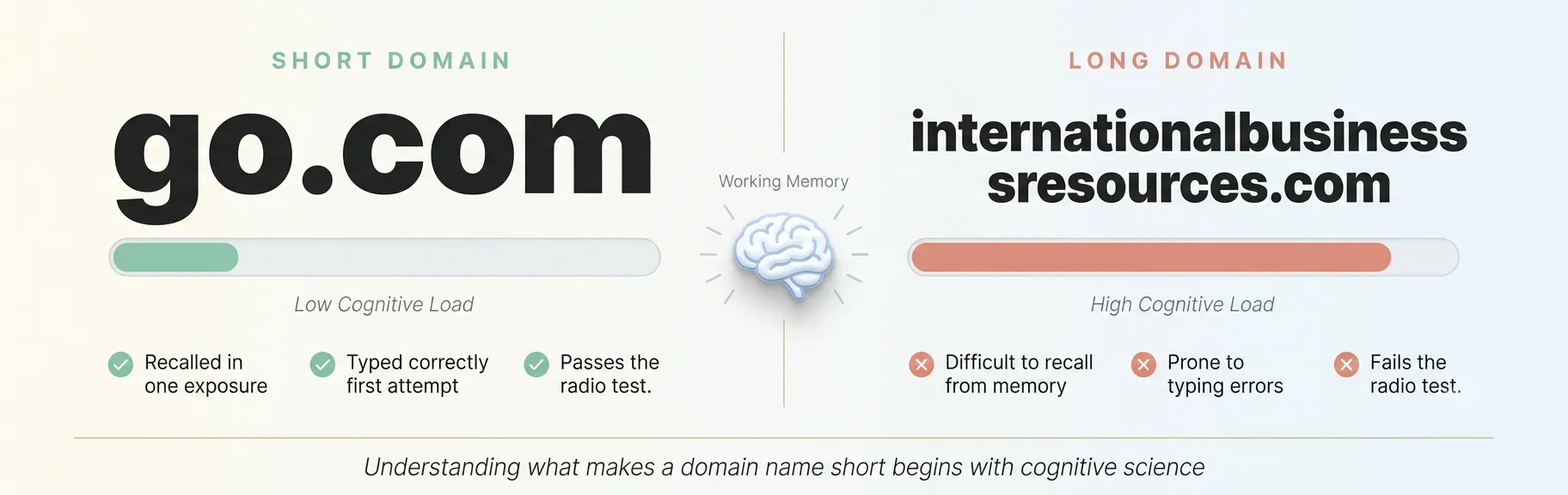
Working memory – the mental workspace where we temporarily hold and manipulate information – operates under strict capacity constraints. Research in cognitive science has consistently demonstrated that humans can reliably hold approximately four chunks of information in working memory at once.
For domain names, each character cluster, syllable, or word functions as a chunk. A domain like “go.com” (two characters) occupies minimal working memory. A domain like “internationalbusinessresources.com” (thirty characters) saturates it entirely.
This has direct, measurable consequences for business performance:
- Direct navigation: Users who remember a domain type it directly, bypassing search entirely
- Word-of-mouth transmission: Short domains survive verbal referral intact; longer ones get garbled
- Advertising efficiency: Every character saved in a URL translates to more space for brand messaging
- Email credibility: Short domains in email addresses signal establishment and authority
- Error rate reduction: Shorter domains produce fewer typos, reducing lost traffic
The cognitive load argument is why the threshold of “six characters or fewer” has become the practical definition of what makes a domain name short from a performance standpoint – not just a visual one.
Short Domain Name vs. Memorable Domain Name: Are They the Same Thing?
This is one of the most important distinctions in domain evaluation – and one that many buyers overlook.
Short and memorable are correlated but not identical.
A domain can be short without being memorable (random character strings). A domain can also be memorable without being technically short – think of brandable names like “Amazon” or “Twitter,” which are six and seven characters respectively and succeed through heavy marketing reinforcement rather than inherent brevity.
The ideal short domain achieves both simultaneously. It is:
- Short enough to reduce cognitive load (six characters or fewer)
- Structured well enough to enable natural recall without reinforcement
- Phonetically clean enough to pass the radio test
- Visually balanced enough to read naturally in print and on screen
When evaluating a short domain purchase, ask: “Would someone who heard this name once be able to type it correctly 24 hours later, with no prompting?” If the answer is yes, the domain is both short and memorable – the highest-value combination in the market.
TLD Impact: Does the Extension Change Whether a Domain Is “Short”?
The TLD (top-level domain) – the .com, .io, .co, .ai, and so on after the dot – is part of the full domain string. However, the “short domain” classification in standard practice refers to the second-level domain (SLD) only.
That said, TLD choice has a significant indirect effect on whether a domain functions as short in the user’s perception:
- .com remains the default TLD globally. A five-letter .com reads as shorter and more authoritative than the same five letters on an obscure TLD.
- Shorter TLDs (.io, .co, .ai) can make the full URL more compact – but they do not change the SLD character count.
- Two-part URL compression using ccTLDs can create domains where the SLD and TLD together form a complete word – a technique called “domain hacking” (e.g., bit.ly). This is a separate strategy from standard short domain acquisition.
For most businesses, the practical guidance is straightforward: prioritize a short SLD on a credible, widely-recognized TLD. A four-letter .com will outperform a two-letter domain on a TLD that users do not recognize or trust.
The Scarcity Equation: Why Short Domains Are Finite Assets
One of the most compelling aspects of short domain names is that they are genuinely finite. Unlike most digital assets, their supply cannot be inflated.
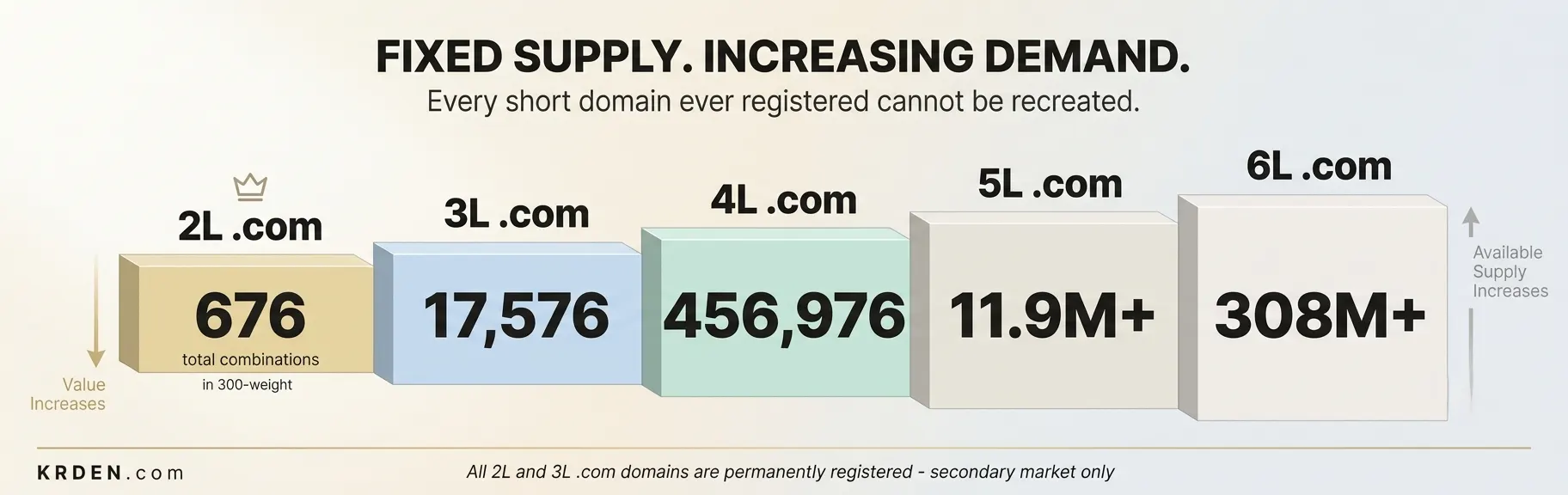
Consider the mathematics:
- 2-letter .com combinations: 676 total (all registered)
- 3-letter .com combinations: 17,576 total (all registered)
- 4-letter .com combinations: 456,976 total (effectively all registered)
- 5-letter .com combinations: ~11.9 million total (largely registered)
- 6-letter .com combinations: ~308 million total (significant portion registered)
As domain scarcity analysis from DN.org notes, once short domains within a given tier are registered, they cannot be recreated or substituted. New registrations of 2L or 3L .com domains are categorically impossible – these assets can only change hands.
This fixed-supply, increasing-demand dynamic is why short domain names function as appreciating digital real estate, not just functional web addresses. Every year, more businesses compete for fewer available short names – driving secondary market values consistently upward.
Common Misconceptions About Short Domain Name Length
Even experienced buyers carry misconceptions about what makes a domain name short and what that length actually delivers. Here are the most prevalent ones, corrected.
Misconception 1: “Any Domain Under 10 Characters Is Short”
Reality: The premium short domain market recognizes six characters as the upper threshold. Seven, eight, and nine-character domains occupy the “medium-length brandable” tier – valuable, but not classified as short domains in standard industry terminology.
Misconception 2: “Short Automatically Means Valuable”
Reality: A random five-character consonant string (e.g., “xvkrb.com”) is technically short but commercially near-worthless. Shortness is a necessary, not sufficient, condition for premium value. Pronounceability, pattern quality, and extension credibility must also be present.
Misconception 3: “Hyphens Make a Longer Domain Effectively Shorter”
Reality: Hyphens in domain names are widely discouraged. They interrupt the reading flow, fail the radio test entirely, and are associated with lower domain quality by both users and search engines. A hyphenated domain is never classified as short regardless of character count.
Misconception 4: “Numbers Compensate for Length”
Reality: Replacing letters with numbers (like “4” for “for”) does not make a domain shorter in any meaningful commercial sense. It introduces ambiguity and spelling variance, which works directly against the core value proposition of short domain names.
Misconception 5: “Any Five-Letter Name Has Equivalent Value”
Reality: Pattern quality within a tier matters enormously. A clean CVCV (consonant-vowel) five-letter name may be worth 10-50x more than a CCCCV (four-consonant) five-letter name – even though both are technically the same length.
What Short Domain Names Actually Do for Your Brand and SEO
Understanding what makes a domain name short is academic if it is not connected to real business outcomes. Here is what the research and market data consistently show.
Brand Recall and Direct Navigation
Short domains are recalled more accurately after a single exposure. This translates directly to increased direct navigation traffic – users who type your domain without searching. Direct traffic is the highest-quality traffic source: these visitors already know and trust your brand.
Earned Media Efficiency
When your domain is mentioned in press coverage, podcasts, video content, or social media, shorter names are reproduced accurately more often. A seven-word domain mentioned verbally in a podcast produces dozens of spelling variants among listeners. A four-letter domain does not.
Email Deliverability and Trust Signals
A short, clean .com domain in an email address projects authority and stability. Recipients make trust judgments about email senders within milliseconds – and a concise, recognizable domain suffix is a material positive signal.
SEO Indirect Benefits
Short domains do not directly improve search rankings. Google’s algorithms do not weight character count. However, short domains drive SEO indirectly through:
- Higher click-through rates in search results (cleaner, more credible-looking URLs)
- Stronger natural backlink acquisition (authoritative-looking domains attract more links)
- Better brand search volume (users search your brand name more often when it is easy to remember)
- Lower bounce rates driven by higher brand recognition pre-click
As Namecheap’s domain value analysis confirms, premium short domain names – especially single-word and short .com names – continue to command top valuations precisely because these compounding business benefits are well-documented.
Advertising ROI
Every paid media impression that includes your domain is more effective when the domain is short. A compact, memorable domain reduces the cognitive steps between ad exposure and site visit – improving conversion rates across search, display, video, and out-of-home advertising simultaneously.
How to Evaluate Whether a Domain is Truly Short Enough to Buy
When assessing a domain name for acquisition, use this structured evaluation framework to determine whether it meets the functional definition of a short domain.
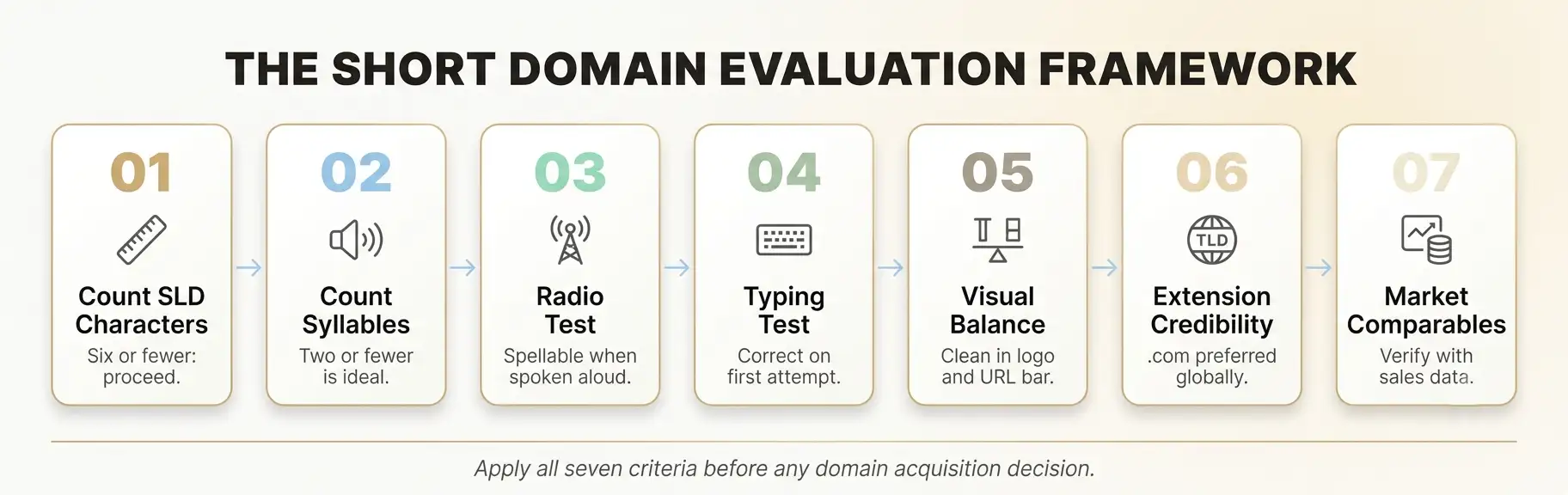
Step 1: Count the SLD characters Count only the characters before the first dot. Six or fewer: proceed. Seven or more: classify as medium-length and adjust your valuation accordingly.
Step 2: Count syllables Say the domain aloud. One or two syllables is ideal. Three syllables is the maximum for a domain that will still feel “short” to users in practice.
Step 3: Run the radio test Imagine hearing the domain spoken on a radio advertisement. Can a listener spell it correctly without additional instruction? If yes, it passes.
Step 4: Check the typing test Type the domain from memory after a 30-second distraction. If you type it correctly on the first attempt, it passes. If you hesitate or make an error, it carries a functional length problem regardless of character count.
Step 5: Assess visual balance View the domain in a browser URL bar, on a business card layout, and as a logo-style wordmark. Short domains should look intentional and refined, not truncated or cryptic.
Step 6: Evaluate extension credibility Confirm the TLD is recognized and trusted by your target audience. .com remains the gold standard. If using an alternative TLD, ensure your industry and audience are comfortable with it.
Step 7: Verify secondary market comparables Check recent sales data for domains of equivalent length, pattern, and extension. Tools such as Namebio’s domain sales database provide historical transaction data that grounds valuation in real market behavior rather than speculation.
Expert Tips for Acquiring Short Domain Names
Tip 1: Distinguish between character shortness and functional shortness. A domain must pass the cognitive, phonetic, and visual tests – not just the character count threshold. Prioritize functional shortness over numerical shortness.
Tip 2: Focus on .com first. For global brands, .com remains unmatched in user recognition and trust. Acquire the .com version of a short name before considering alternatives.
Tip 3: Prioritize real words and pronounceable patterns. Short dictionary words and CVCV invented names outperform random character strings in every commercial metric. “Bixo.com” is more valuable than “xbwk.com” despite identical character count.
Tip 4: Verify the name has no negative associations. Run cross-language checks before committing. A four-letter name that is an offensive acronym in any major language creates brand risk that no amount of shortness can offset.
Tip 5: Consider acquisition timing carefully. Short domain values have trended upward consistently over the history of the commercial internet. If a short domain aligns with your brand criteria and is available at a reasonable secondary market price, acquiring sooner is generally preferable to waiting.
Tip 6: Work with specialized short domain curators. Focused short domain marketplaces apply quality filters that reduce noise significantly – shortening your evaluation time and reducing the risk of acquiring a technically short but commercially weak asset.
Comparison: Short Domain Name Tiers vs. Business Use Cases
| DOMAIN TIER | CHARACTER COUNT | BEST SUITED FOR | TYPICAL MARKET RANGE | AVAILABILITY |
|---|---|---|---|---|
| 2L .com | 2 characters | Global corporations, financial acronyms | $500K – $5M+ | Secondary market only |
| 3L .com | 3 characters | Tech startups, established brands, acronyms | $5K – $500K | Secondary market only |
| 4L .com | 4 characters | Startups, scaleups, investment platforms | $1K – $50K | Secondary market only |
| 5L .com | 5 characters | Early-stage brands, SaaS products | $500 – $20K | Limited; mostly secondary |
| 6L .com | 6 characters | SMBs, professional services, niche brands | $200 – $5K | Some primary availability |
| 7-9 char .com | 7-9 characters | General business, local services | $10 – $2K | Moderate availability |
Ranges are indicative and vary based on pattern quality, pronounceability, and acronym value.
FAQ: What Makes a Domain Name Short?
Q1: What is the official definition of a short domain name? There is no single official governing body definition. Within the domain industry, a short domain name is generally defined as a second-level domain containing six characters or fewer. Premium short domain classifications use narrower tiers: 2L, 3L, 4L, 5L, and 6L.
Q2: What makes a domain name short enough to be considered premium? A premium short domain combines low character count (six or fewer), high pronounceability, strong spelling predictability, a credible TLD (ideally .com), and no negative semantic associations. Character count alone is insufficient – the domain must also pass the radio test and cold-recall typing test.
Q3: Does a shorter domain name rank better in Google search? Not directly. Google does not use character count as a ranking signal. However, short domains drive SEO indirectly through higher click-through rates, stronger brand search volume, and greater natural backlink acquisition – all of which correlate with improved organic visibility over time.
Q4: Is a 7-character domain considered short? By strict industry standards, a 7-character domain falls outside the “short domain” premium classification, which caps at six characters. Seven-character domains occupy the “medium-length brandable” category – still commercially valuable, but not classified as short in standard domain market terminology.
Q5: Why are short domain names so expensive? Short domain names are expensive because their supply is mathematically fixed. Every possible 2L, 3L, and most 4L .com combinations have been registered. New short domains cannot be created – they can only be transferred on the secondary market. Increasing demand combined with permanently fixed supply produces sustained price appreciation.
Q6: What is the “radio test” and why does it matter? The radio test is a domain evaluation method: imagine hearing the domain read aloud on a radio advertisement, with no visual reference. If a listener can spell the domain correctly and find the site without additional instruction, it passes. This test identifies whether a domain is functionally short – not just numerically short.
Q7: Where can I find short domain names for sale? Curated short domain name inventories are available through specialized marketplaces. KRDEN maintains a focused selection of short domain names for sale, with each listing evaluated against strict criteria for character count, pronounceability, extension quality, and brandability. General marketplaces like Sedo, Afternic, and Dan.com also list short domains, though with less curation.
The Definition is the Foundation
What makes a domain name short is a question with a precise answer – and a more nuanced one.
At the technical level, a short domain contains six or fewer characters in the second-level domain. At the commercial level, that character constraint must be accompanied by phonetic clarity, cognitive accessibility, visual compactness, and TLD credibility to deliver the full business value that the “short domain” classification implies.
The definition matters because acquisition decisions are irreversible. A domain acquired for significant capital on the assumption of shortness – only to fail the radio test, the spelling test, or the memorability test in practice – is a misallocation that compounds over time.
Understanding the real definition of a short domain name does not just help you buy better. It helps you build better: a brand identity that users remember without effort, share without distortion, and return to without searching.
If you are ready to find a domain that meets every criterion in this framework, explore our complete inventory of premium short domain names for sale at KRDEN – all rigorously curated for length, pronounceability, extension quality, and commercial viability.
Pingback: How to Buy a Short Domain Name: Search to Transfer
Pingback: Short Domain Buying Mistakes: 9 Costly Errors to Avoid